

What exactly is Clean Core?
Clean Core in SAP development refers to a strategic approach aimed at keeping the core of an SAP S/4HANA system as close to standard as possible, free from custom modifications. This approach prevents customizations from hindering standard SAP software and helps organizations adapt their systems to changing business requirements and adopt new capabilities. The goal is to minimize custom code and invasive changes, instead leveraging scalable, side-by-side tools like SAP Business Technology Platform (BTP) for extensions.
Clean Core Principles
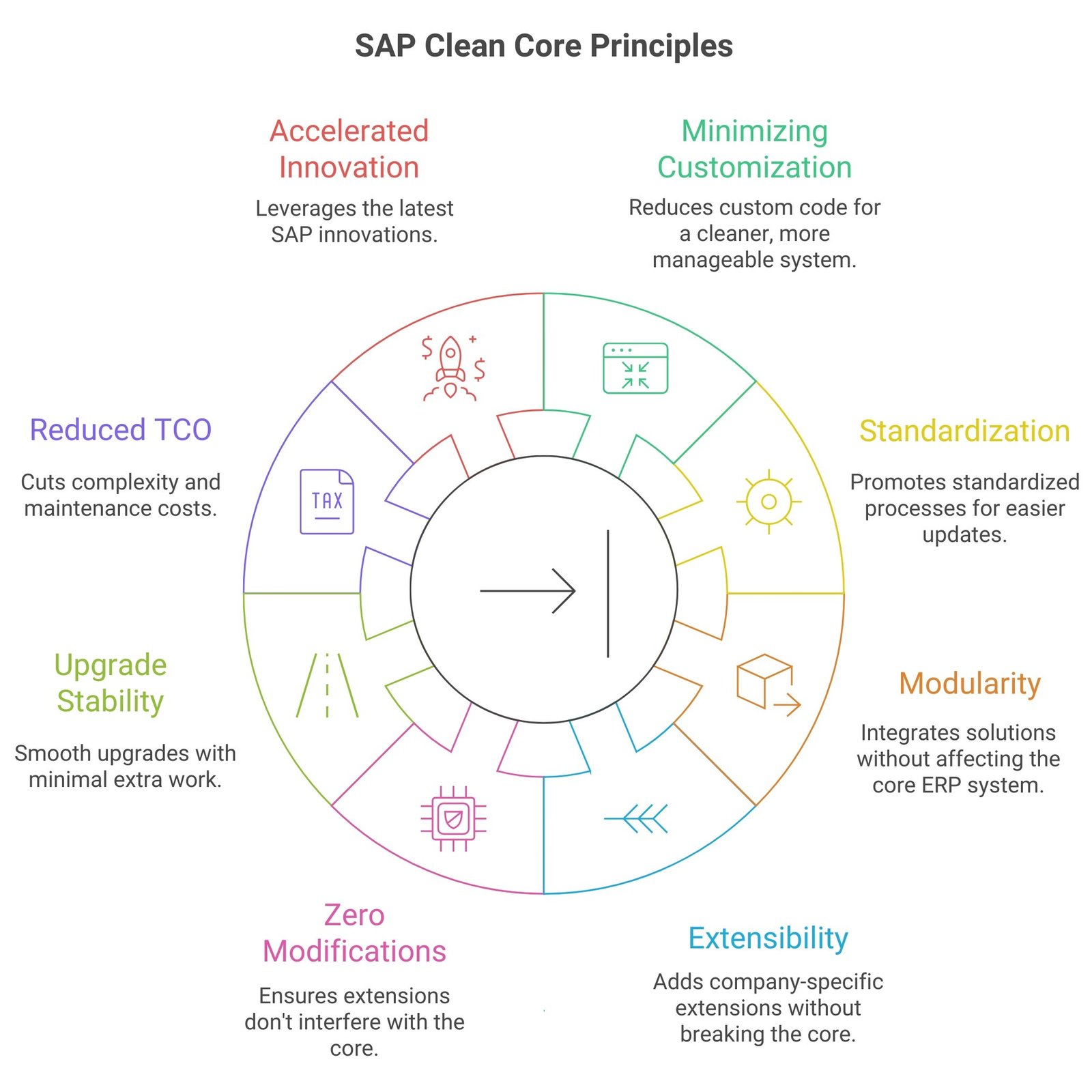
The SAP Clean Core strategy focuses on minimizing custom code in the core ERP system to enable smoother upgrades, better system stability, and future-ready cloud transformation. Key principles include:
- Minimizing Customization to limit custom code and heavy customizations, making the core system cleaner and more manageable.
- Standardization by promoting the use of standardized processes and best practices to benefit from the latest SAP innovations and updates without extensive rework.
- Modularity to integrate various SAP and third-party solutions without affecting the core ERP system.
- Extensibility through guardrail mechanisms for adding company-specific extensions that are integrated with the core but preserve the ability to update the core without breaking custom code. Extensions should be designed to be stable through upgrades, reducing the need for frequent adjustments.
- Zero Modifications to the core, meaning extensions and integrations must not interfere directly with the SAP core but must be implemented using released extension points, standard APIs, and documented interfaces.
- Upgrade Stability to ensure upgrades proceed smoothly with little to no extra work, keeping the system up-to-date and secure.
- Reduced Total Cost of Ownership (TCO) by cutting complexity, maintenance efforts, testing costs, and increasing automation.
- Accelerated Innovation by leveraging the latest SAP innovations, including AI, ML, and automation, which often depend on a simplified, standardized core.
Five Dimensions of Clean Core
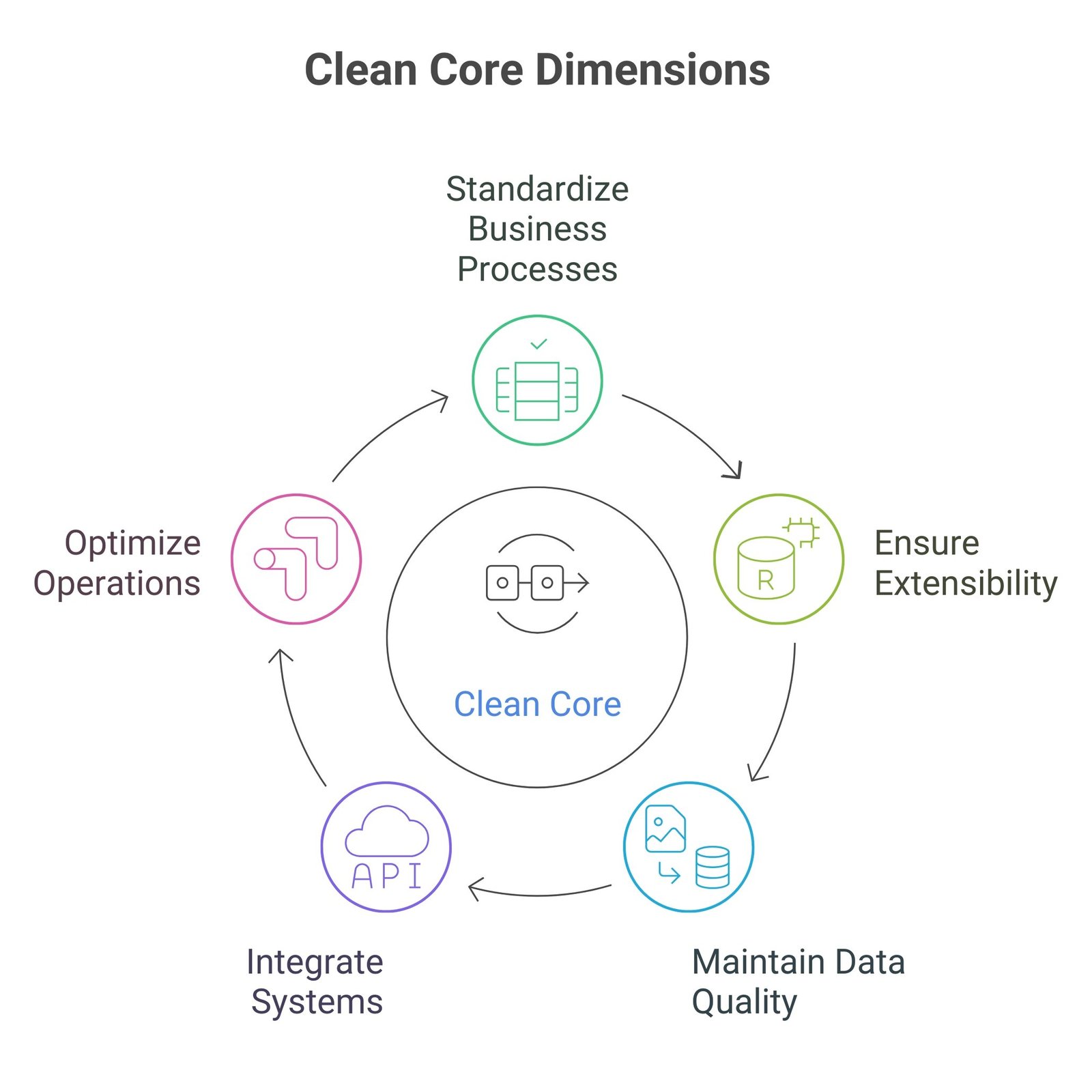
Clean Core is not just about extensibility; it’s a holistic approach covering several dimensions:
- Business Processes: Keeping processes as standard as possible, and individual only when necessary, aligning with SAP Best Practices and focusing on efficiency and visibility.
- Extensibility: Creating custom features without altering core code, using defined extension points and reliable development and extension technologies to reach upgrade stability.
- Data: Ensuring data is clean, consistent, complete, correct, up-to-date, and purpose-driven, often involving data cleansing activities and data governance frameworks.
- Integration: Connecting systems through standardized, API-based connections,
leveraging tools like SAP Integration Suite to keep the landscape reliable. - Operations: Focusing on efficient and secure operations, including lifecycle events, maintenance windows, “housekeeping” (technical, licenses), governance, technical transparency, monitoring, and automation.
Clean Core Vs Traditional approach
Comparing the Clean Core approach with the traditional approach in SAP development reveals a fundamental shift in strategy, particularly driven by the move to cloud-based ERP systems like SAP S/4HANA. While the traditional approach focused on deeply embedding customizations within the core system, Clean Core advocates for keeping the core as standard as possible and externalizing custom logic. Here’s a comparison of these two approaches:
- Customization and Extensibility
● Clean Core: Employs a differentiated extension concept using various scenarios:
○ In-App Extensibility (Key User Extensibility): Allows power users to create custom fields, business objects, analytical queries, or UI adaptations directly in Fiori using low-code/no-code principles.
○ On-Stack Extensibility with ABAP Cloud: For more complex extensions within the SAP stack using the ABAP RESTful Application Programming Model (RAP) and released APIs in a dedicated, modification-free, cloud-compliant environment. ABAP Cloud enforces clean core by design.
○ Side-by-Side Extensibility on SAP Business Technology Platform (BTP): Offers the greatest flexibility for complex, cross-module, or mobile applications developed and operated independently of the core system. Technologies like SAP Build Apps, SAP Build Code, CAP, or SAP Integration Suite enable loosely coupled extensions that function independently of the core.
○ The Clean Core Level Concept (Levels A, B, C, D) provides a more granular assessment of custom extensions, classifying them from cleanest (Level A, fully compliant with stable SAP interfaces) to not clean (Level D, severe violations like modifications or non-recommended objects).● Traditional Approach: Relied on direct manipulation of core SAP objects, using classic ABAP, implicit enhancements, or modifying SAP standard screens. These customizations were often tightly coupled with the core system.
- Technical Debt
● Clean Core: Minimizes technical debt by limiting custom code and heavy customizations, making the core system cleaner and more manageable. Legacy code is isolated or retired.● Traditional Approach: Results in high technical debt due to unmanaged, deeply embedded, and scattered changes, as well as the usage of non-recommended SAP objects or technologies.
- Flexibility and Agility
● Clean Core: Achieves higher agility and flexibility, enabling faster response to changing business needs and quicker rollout of new features and innovations (including AI, ML, automation). It ensures extensions are done with long-term stability, scalability, and innovation-readiness in mind.● Traditional Approach: Heavy custom code limits flexibility, slows down upgrades, and makes it harder to leverage the latest SAP innovations. Development practices can become a lagging factor instead of a leading edge for innovation.
- Development Practices and Mindset
● Clean Core: Requires a shift in mindset from traditional on-premise approaches to cloud-centric models. It empowers teams with knowledge of SAP’s recommended programming models like RAP and CAP, encouraging a cloud-centric approach. Developers use modern tools and strictly defined APIs.● Traditional Approach: Developers were accustomed to greater freedom in modifying SAP objects directly. The traditional “WRICEF” (Workflows, Reports, Interfaces, Conversions, Enhancements, Forms) model was common.
- Challenges and Disadvantages
● Clean Core: Requires acquiring new knowledge and skills (e.g., ABAP Cloud, BTP, API-based development). It demands a cultural shift and can face resistance from stakeholders accustomed to older methods. Some simple adjustments in a non-Clean Core system might become more complex in a Clean Core system. There can be initial time and cost overhead for setup and training.● Traditional Approach: While offering immediate flexibility in making direct changes, it posed long-term problems. Challenges included managing an increasing volume of custom code, difficulty in tracking dependencies, and the eventual impact on upgrades and system performance.
Technical skills
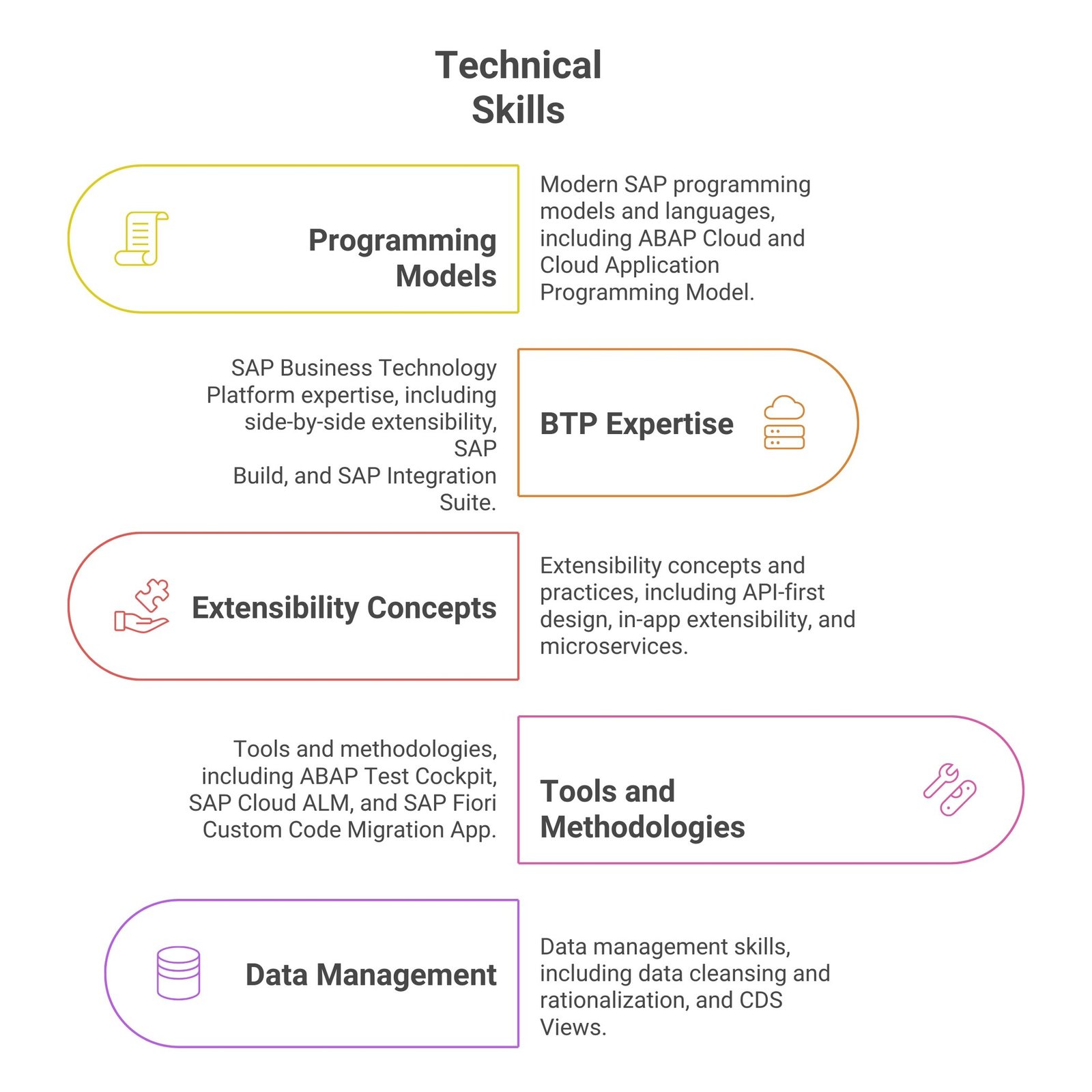
Implementing a Clean Core approach in SAP S/4HANA requires a significant shift in technical skills and a departure from traditional on-premise development practices. This transition empowers teams with modern tools and cloud-centric programming approaches. Here are the key technical skills needed to implement a Clean Core:
- Modern SAP Programming Models and Languages
● ABAP Cloud Development Model (ABAP RESTful Application Programming Model – RAP)
● Cloud Application Programming Model (CAP) - SAP Business Technology Platform (BTP) Expertise
● Side-by-Side Extensibility
● SAP Build
● SAP Integration Suite - Extensibility Concepts and Practices
● API-First Design
● In-App (Key User) Extensibility
● Microservices - Tools and Methodologies
● ABAP Test Cockpit (ATC)
● SAP Cloud ALM
● SAP Fiori Custom Code Migration App
● ABAP Development Tools (ADT)
● SAP Data Migration Cockpit
● RISE with SAP Methodology - Data Management Skills
● Data Cleansing and Rationalization
● CDS Views
Benefits of SAP Clean Core
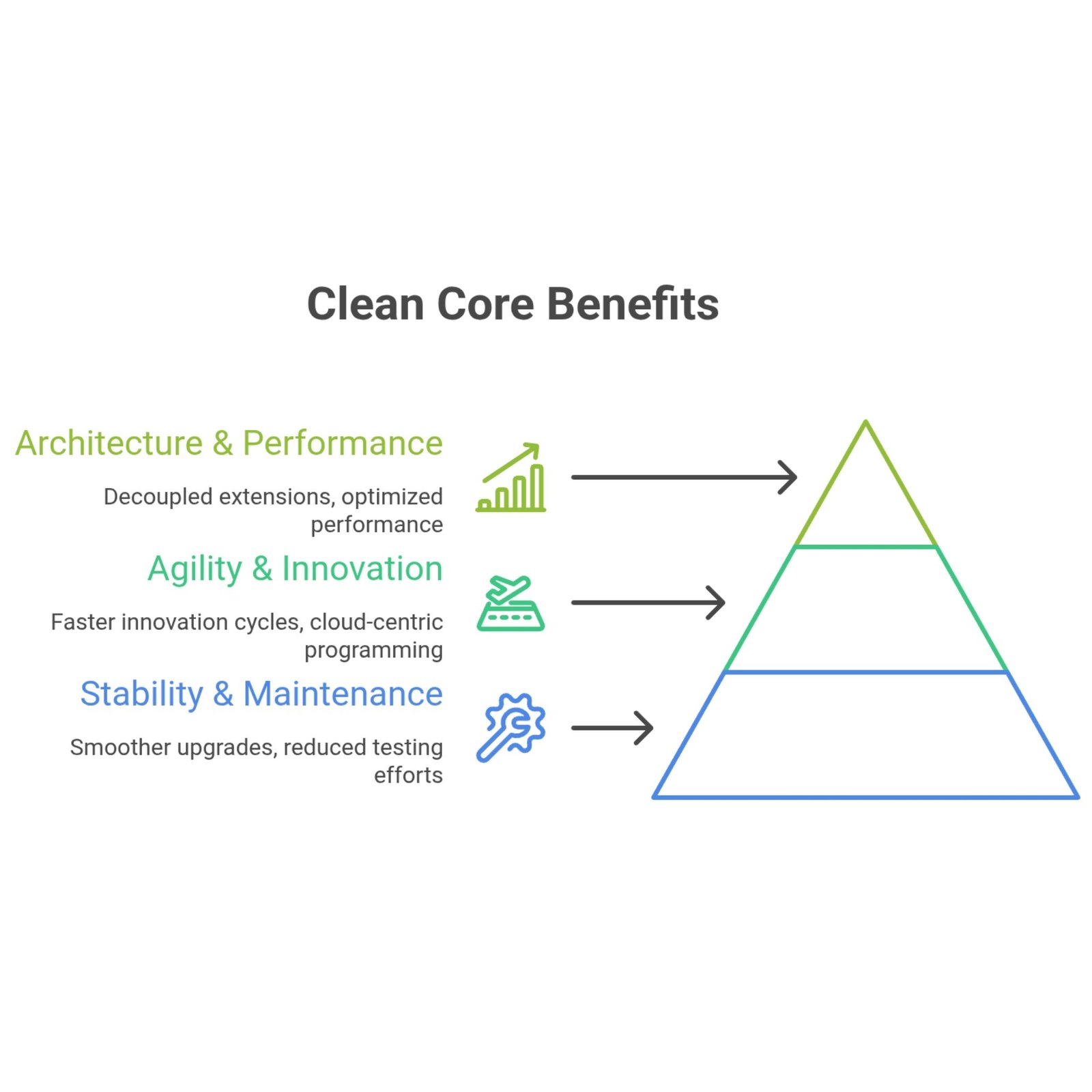
Implementing a Clean Core strategy offers numerous advantages, fundamentally transforming how organizations manage their SAP S/4HANA systems to enhance agility, reduce costs, and accelerate innovation. Here are the key benefits associated with a Clean Core approach:
- Upgrade Stability and Simplified Maintenance
○ Smoother and Faster Upgrades: By minimizing or avoiding direct modifications to the core SAP system, Clean Core ensures that upgrades proceed smoothly with little to no extra work, allowing systems to remain up-to-date and secure. Organizations can experience up to a 40% reduction in upgrade costs and 30% to 50% faster release cycles.
○ Reduced Testing Efforts: Simplified architecture and decoupled extensions lead to smaller, faster test cycles, with QA teams spending less time on edge cases caused by outdated customizations.
○ Lower Maintenance and Support Costs: Fewer customizations and a standardized approach reduce ongoing support and maintenance costs, freeing up resources for innovation and growth.
○ Avoid Technical Debt: Prioritizing a clean core and implementing cloud-compliant extensions prevents the accumulation of technical debt, which often diverts a significant portion of the technology budget. Hitachi High-Tech, for example, achieved a 94% reduction in customization footprint. - Enhanced Agility and Innovation
○ Faster Innovation Cycles: A Clean Core allows organizations to leverage the latest SAP innovations and technologies, including AI and machine learning, more quickly and with less disruption. New business functionality can go live 40% to 60% quicker.
○ Increased Flexibility and Adaptability: The approach fosters higher agility in responding to changing business needs or market conditions, as teams can roll out new features faster without tightly coupled dependencies.
○ Cloud-Centric Programming Approach: It encourages adopting modern programming models like the ABAP RESTful Application Programming Model (RAP) and Cloud Application Programming Model (CAP), empowering teams with cloud-centric development skills.
○ Empowered Business-Led Development: Low-code/no-code tools like SAP Build enable functional teams to prototype workflows and automate steps without relying heavily on developers or violating IT policies, fostering greater business agility. - Improved System Architecture and Performance
○ Decoupled Extensions: Customizations and extensions are built outside the core system, often on SAP Business Technology Platform (BTP), ensuring they do not interfere with standard SAP software and maintain upgrade stability. This prevents “core pollution”.
○ Standardized API-Based Connections: Clean Core promotes the use of standard, publicly released APIs for integration and extension, leading to a reliable and flexible integration landscape.
○ Optimized Performance: Offloading custom applications to SAP BTP can reduce the load on the core SAP S/4HANA system, enhancing overall performance.
○ Efficient Data Management: A Clean Core supports higher data consistency and accuracy, encouraging data cleansing, rationalization, and the implementation of robust data governance frameworks.
Sources
Managing Clean Core for SAP S/4HANA Cloud
ABAP Extensibility Guide – Clean Core for SAP S/4HANA Cloud – August 2025 Update
10 Steps to Clean Core for SAP S/4HANA Cloud Private Edition for Customers
Clean Core: A paradigm shift for SAP applications
Clean Core in actual Practice
SAP Clean Core Strategy Guide: My Practical Steps for 2025