
What is an odata in SAP?
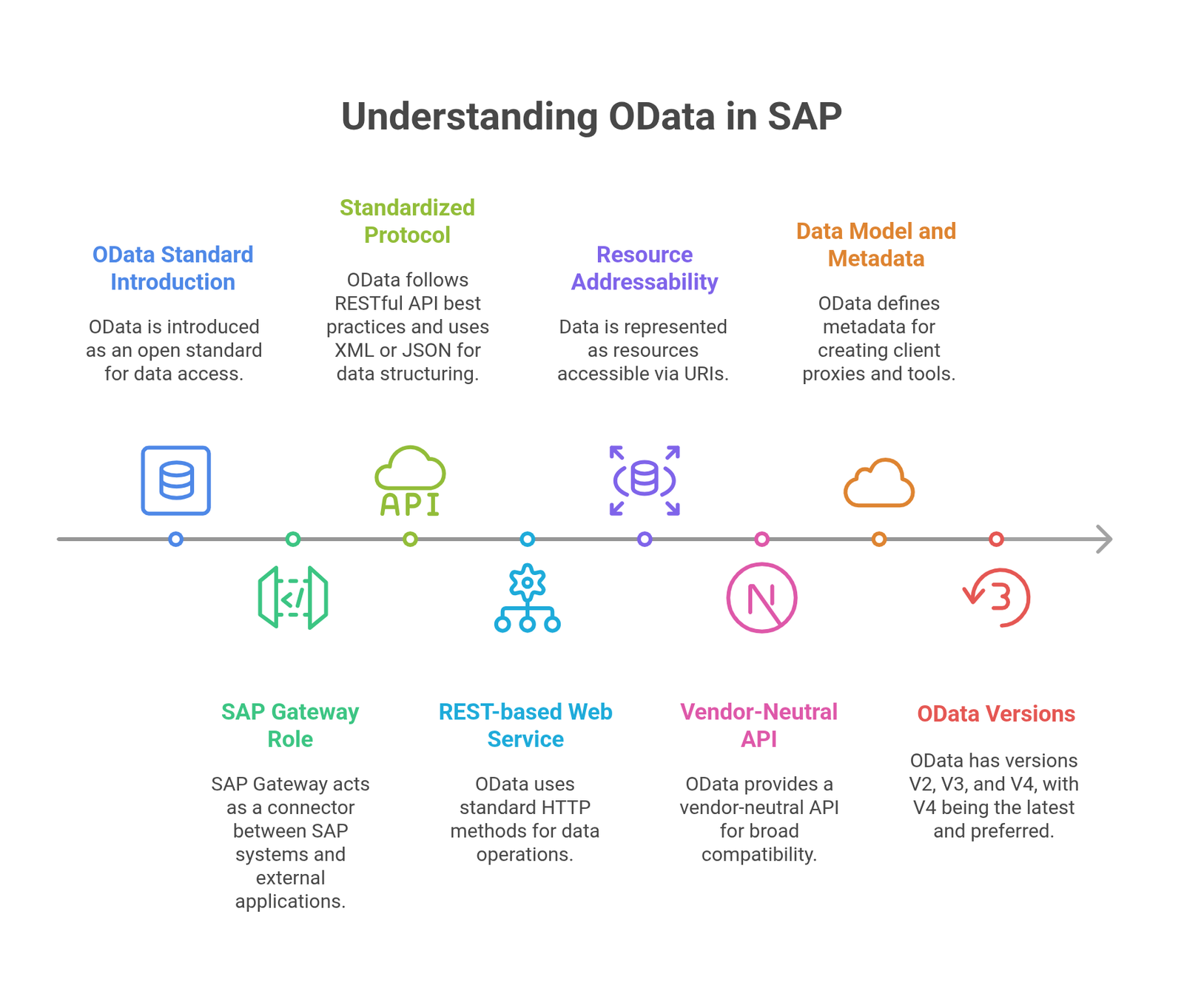
OData, or the Open Data Protocol, is a widely-used open standard that provides a way to access and manipulate data in a simple and structured way, making it easier for developers to work with data across different platforms and technologies. In the SAP ecosystem, OData serves as a crucial component for integration and efficient data access. The SAP Gateway acts as a connector, translating between ABAP APIs and OData entities. This enables seamless integration between SAP systems and external applications.
Here’s a breakdown of what OData is in SAP:
- Standardized Protocol: OData is an OASIS standard that defines best practices for building and consuming RESTful APIs. It is based on Atom Publishing and Atom Syndication standards, which use XML and HTTP(S). JSON is also a common alternative for structuring data.
- REST-based Web Service: OData follows the Representational State Transfer (REST) architecture design paradigm, transferring representations of the state of resources. This means it uses standard HTTP methods (GET, POST, PUT, DELETE) for operations on data.
- Resource Addressability: Data is represented as “resources” which are addressable and accessible via Uniform Resource Identifiers (URIs). A client sends a request to a URI to access or manipulate data, and the server processes it to assemble a response.
- Vendor-Neutral API: A main objective of OData is to provide a vendor-neutral, web-based API that fully complies with REST design principles. This allows any client platform supporting OData to communicate with any server supporting the same contract.
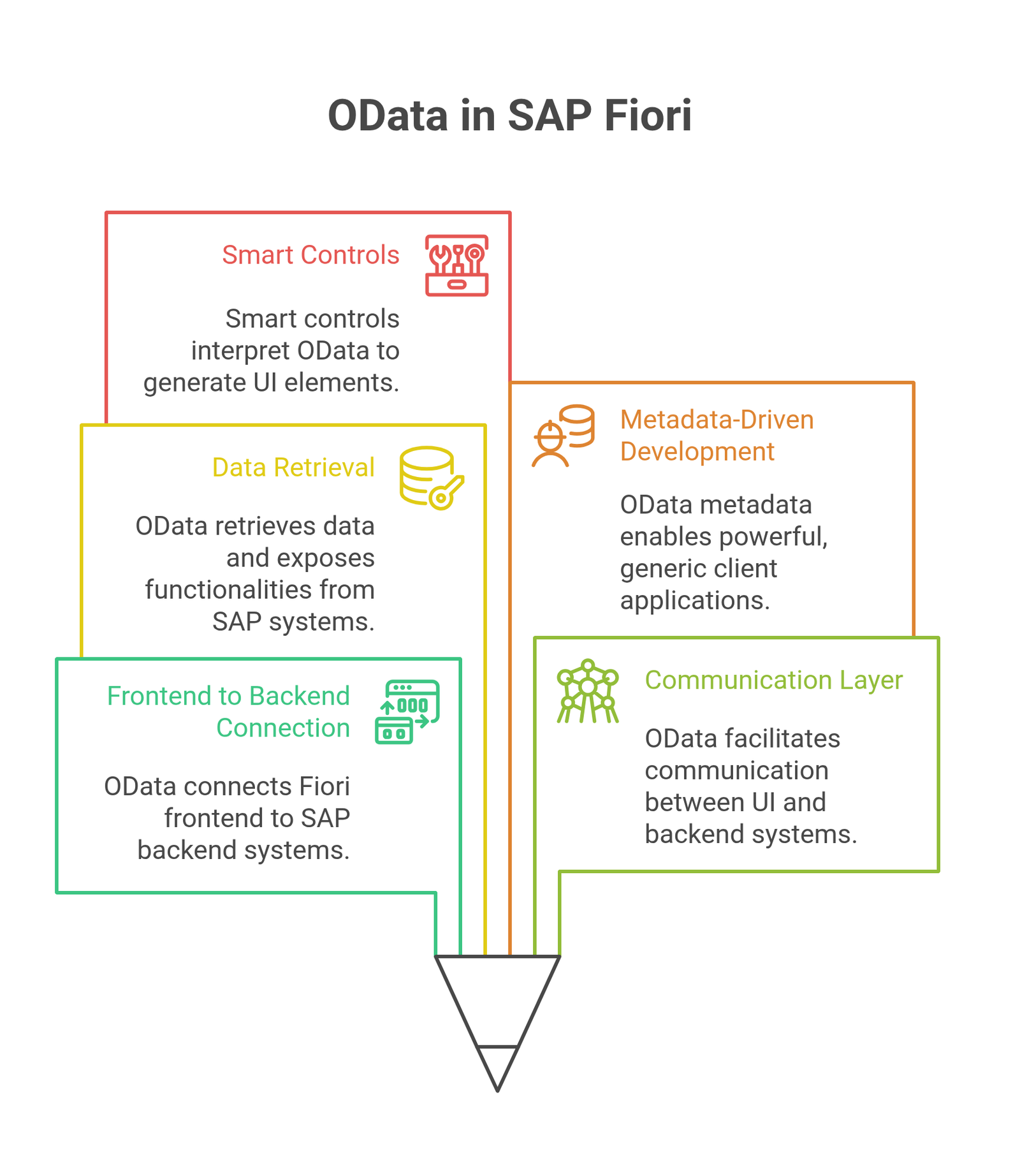
- Data Model and Metadata: OData defines a machine-readable metadata description of the APIs’ data model, enabling the creation of powerful generic client proxies and tools. This metadata helps developers or systems like SAPUI5 to automatically connect to services and generate customized user interfaces.
- Versions: OData is available in versions 2 (V2), 3 (V3), and 4 (V4), with newer versions extending previous ones. SAP Gateway supports OData V2 since AS ABAP 7.00 and OData V4 since AS ABAP 7.50, skipping OData V3. OData V4, published in 2014, is the latest version and the preferred format for modern web technologies and SAP S/4HANA environments, with JSON as its main format.
Uses of Odata in SAP
OData offers several compelling benefits and is widely adopted across the SAP ecosystem for various integration and application development scenarios:
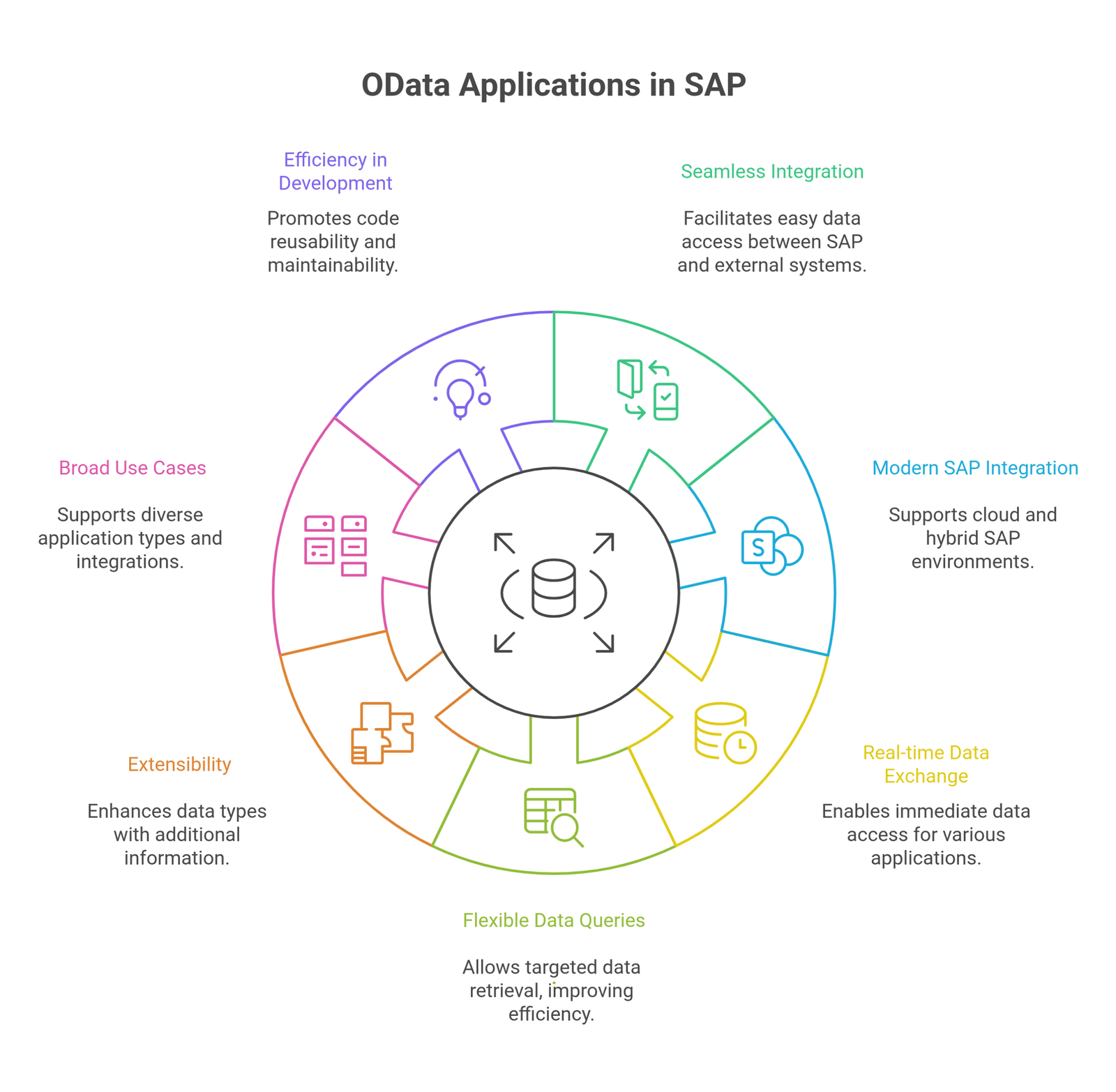
- Seamless Integration and Data Access: It acts as a bridge, allowing external applications to easily access SAP data and processes. This simplifies the development and deployment of SAP-based applications and the integration of non-SAP applications.
- Foundation for Modern SAP Integration: OData APIs are the foundation of modern SAP integration, especially for SAP S/4HANA Cloud and Fiori applications. They are ideal for hybrid SAP landscapes, supporting both on-premise and cloud deployments.
- Real-time Data Exchange: OData APIs enable real-time, stateless communication over HTTP(s). This makes them ideal for scenarios requiring immediate data access, such as mobile apps, dashboards, and cloud applications.
- Flexible Data Queries: OData allows for targeted queries with extensive filter and selection options, significantly reducing the amount of data transferred and improving efficiency. It supports complex data models, including nested structures and relationships between data objects.
- Extensibility: OData is extensible, allowing SAP to supplement its data types with extra information from the ABAP Data Dictionary. This also supports metadata-driven development for web and mobile applications like SAP Fiori elements.
- Broad Use Cases: OData can be consumed by various application types, including mobile apps, web apps, and for reporting and integration purposes. Typical use cases include integrating third-party cloud systems (e.g., Salesforce, Shopify), powering custom UIs via SAP Fiori, and mobile app integration.
- Efficiency in Development: It leads to a higher degree of reusability and maintainability of code. Developers can quickly adapt existing services and integrate them into new applications, with less programming effort due to simple modeling with CDS and ABAP.
In essence, OData in SAP breaks down data barriers and maximizes the power of the SAP ecosystem by delivering a standardized, flexible, and secure method for accessing and sharing business data across platforms.
Role of OData in SAP Integration Suite
OData plays a critical role within the SAP Integration Suite as a standardized open protocol for accessing and manipulating data, facilitating seamless integration and data exchange across diverse systems and platforms. Here’s how OData functions within the SAP Integration Suite and why it is useful:
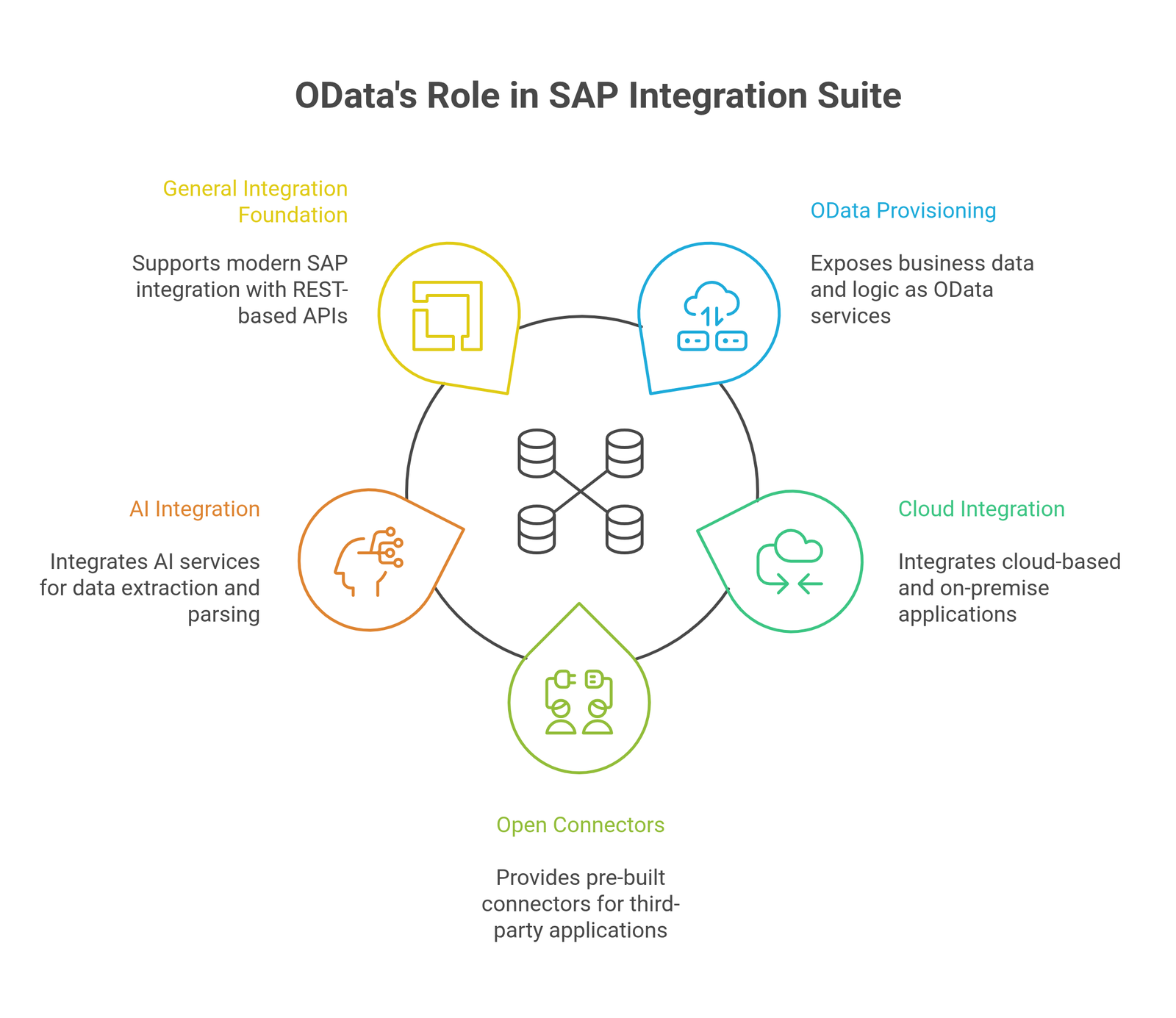
- Exposing Business Data and Logic: OData Provisioning, as a capability of SAP Integration Suite, facilitates exposing business data and logic from SAP Business Suite systems as OData services on the SAP Business Technology Platform (SAP BTP). This eliminates the need for extra development efforts and enables customers to create and run user-centric applications seamlessly on the SAP Cloud.
- Cloud Integration: OData is extensively used within the Cloud Integration capability of SAP BTP Integration Suite. This ensures the platform’s ability to facilitate the seamless integration of various cloud-based and on-premise applications and services by leveraging robust features and functionalities.
- Open Connectors: As an integral component of SAP BTP Integration Suite, Open Connectors provide pre-built, standardized connectors that simplify the integration process by enabling seamless connectivity between the Integration Suite and a wide range of third-party applications and services. These connectors standardize data retrieval and interaction with diverse APIs, abstracting complexities, which can include OData interactions.
- Integration with AI Capabilities: SAP BTP Integration Suite, through its Cloud Integration capabilities, can integrate with Artificial Intelligence (AI) services. For example, it can handle document uploads and direct them to a Document Extraction service (a BTP service that extracts data using machine learning models), with Cloud Integration then managing parsing results and notifications, potentially relying on OData for structured data exchange.
- General Integration Foundation: OData APIs are REST-based web services and are the foundation of modern SAP integration, particularly for SAP S/4HANA Cloud and Fiori applications. They are ideal for hybrid SAP landscapes, supporting both on-premise and cloud deployments.
Fundamentally, OData acts as a critical data connector and standardizer within the SAP Integration Suite, enabling robust, secure, and efficient communication for a wide array of integration scenarios across SAP’s diverse landscape and external applications.