
My Latest Achievement: Completing the Master in SAP Integration Suite at Logali Group
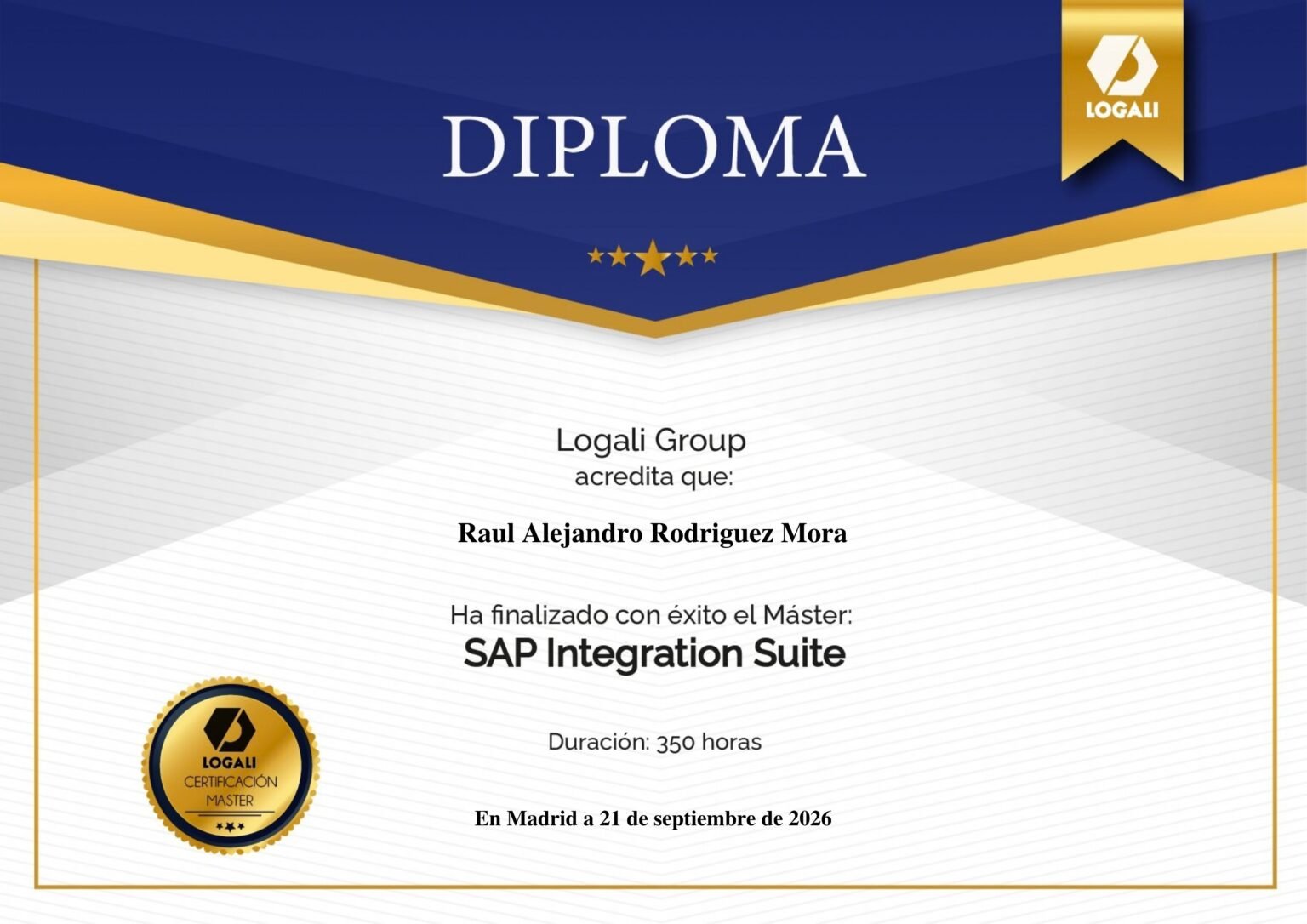
On September 21, 2026, I received my diploma for the Master in SAP Integration Suite from Logali Group, a 350-hour program that took me through every major part of SAP’s cloud integration platform.
Logali Group is well known as a Spanish-speaking SAP training company with a large catalog of courses, workshops and master programs covering ABAP, Fiori, BTP and Integration Suite. The group also runs consulting and engineering arms, so the training is shaped by people who deliver SAP projects themselves.
The Master in SAP Integration Suite is an advanced-level program that combines recorded video lessons, live Saturday sessions with the instructor, weekly hands-on labs, a test at the end of each module, and a final business project. It is also designed as preparation for the official SAP C_CPI certification. My coach was Deimer Angulo, an SAP Certified Integration Developer who works with Cloud Integration, API Management and Open Connectors on real projects. His practical approach made a real difference: every concept came with a lab where you build, deploy and break things in your own BTP subaccount.
What exactly does the program cover?
The program is organized into 13 blocks: architecture fundamentals (BTP accounts, Cloud Foundry, Discovery Center), Cloud Integration, API artifacts, scripting and mapping, SAP HANA Cloud, Event Mesh, Cloud Connector and Solace, API design and security, API monitoring and monetization, SAP Graph, Open Connectors, Integration Advisor for B2B, and SAP’s Integration Solution Advisory Methodology (ISA-M).
Cloud Integration: This is the core of the program and of the platform. Part I covers the building blocks: creating, importing and exporting integration packages; designing an integration flow; configuring participants and adapters; and working with processes, events, mappings, transformations and converters. Part II moves into patterns you need in production: Request-Reply calls, content-based routing, the Aggregator, persistence with Data Store Operations and Write Variables, security artifacts, monitoring, and the Apache Camel foundation with its Simple Expression Language.
API Artifacts: Recent Integration Suite releases added dedicated API artifacts, which let you build REST, SOAP and OData services directly in Cloud Integration. The block covers REST API implementation, synchronous and asynchronous SOAP APIs, and a full OData API artifact with Query, Create, Read, Update and Delete operations.
API Design and Security: covers the full lifecycle of an API. You create API providers that point to backend systems, build API proxies from a URL or directly from an integration flow, bundle them into products, and learn to copy, export, import and debug them. The security half is where API Management shows its real value. Using the SAP Gateway Demo System as a backend, you apply policies for authentication (Basic Authentication, API key verification), traffic management (quotas, spike arrest), mediation (transforming requests and responses without touching the backend), and extension policies with custom logic.
SAP HANA Cloud: This block covers SAP HANA Cloud from the ground up: architecture and concepts, entitlements, subscription, Data Lake instances, the HANA Cockpit, the Database Explorer, and creating database artifacts through the SQL Console. It finishes with building a data model and connecting it to Cloud Integration through the JDBC adapter.
Cloud Connector: Most real SAP landscapes are hybrid. The ERP runs on-premise or in a private cloud, while the integration platform lives in BTP. The Cloud Connector is the secure bridge between the two. This block covers the BTP Connectivity and Destination services, installing the Cloud Connector, connecting it to a subaccount, and exposing backend systems through virtual hosts with access limited to specific resource paths.
Open Connectors: Open Connectors gives Integration Suite access to more than 170 prebuilt connectors for third-party SaaS applications such as Salesforce, HubSpot, Dropbox and many others. The block covers authenticating connector instances, testing them, building common resources with and without templates, creating formulas and Formula-as-a-Resource (FaaR), querying with OCNQL, and finally calling Open Connectors APIs from an iFlow.
The final project: automating "Lead-to-Order"
The main objective of this project was to design and implement an end-to-end integration solution connecting cloud systems (SAP BTP Integration Suite and Salesforce) with Logali Group’s on-premise SAP S/4HANA system.
Specific Objectives
- Product creation: When a sales opportunity is marked as “Closed Won” in Salesforce, a product is created in SAP S/4HANA.
- Expose a product query service: Create and publish a secure API that lets business partners check a product’s status using its identifier.
To achieve these goals, I carried out the following activities:
- Cloud connector: I installed and configured the Cloud Connector in my laptop, where it acts as a secure tunnel between SAP BTP and the on-premise SAP S/4HANA system.
- Salesforce preparation: I created a free Salesforce Developer Edition account, which includes API access by default. Then I added a custom Text field to the Opportunity object (Setup > Object Manager > Opportunity > Fields & Relationships), labeled “Integration Status” with a length of 20 and the API name Integration_Status__c. The iFlow uses this field as a processing flag: it only picks up “Closed Won” opportunities where the field is empty, and sets it to “Processed” once the product is created in SAP S/4HANA, so no opportunity is processed twice.
- Process SalesOrder from Salesforce iFlow: A timer triggers the flow every five minutes. It queries Salesforce through Open Connectors for opportunities with the stage “Closed Won” and an empty Integration_Status__c field, converts the response to XML, and splits it so each opportunity is processed individually. For each one, the flow reads the related Account (a router ends the message with an error if the Account ID is missing), combines both payloads, and uses a Message Mapping to build the ProductDraft structure. Through the Cloud Connector, it creates the ProductDraft in SAP S/4HANA with the OData adapter, completes it with a PATCH, and activates it with the ActivateProduct function import. Finally, it updates the opportunity in Salesforce to “Processed.” Groovy scripts log each key step, and an exception subprocess captures any errors.
- Query OrderStatus from S4HANA iFlow: This flow exposes a synchronous HTTPS endpoint (/order.status) protected by role-based authentication. The caller sends the product ID in the productId header, and the flow reads the product from SAP S/4HANA through the Cloud Connector with the OData adapter (Products(Id=’${header.productId}’)), returning its main details: name, description, price, currency, stock quantity, category and supplier. Groovy scripts log both the incoming request and the S/4HANA response, and an exception subprocess captures any errors. This endpoint is the backend for the API proxy published in API Management.
- API Management: I created an API proxy on top of the Query_OrderStatus_from_S4HANA endpoint and secured it with two policies: Verify API Key, so only registered consumers can call it, and Quota, which limits each consumer to five requests per minute. I then bundled the API into a product, published it on the developer portal where partners can discover it and subscribe to get their keys, and finally created a rate plan and assigned it to the product, showing how the API could be monetized.
Why Does This Matter for My Professional SAP Career?
SAP has made its direction clear. SAP Process Orchestration 7.5 reaches the end of mainstream maintenance in 2027, and SAP Integration Suite is the strategic successor. At the same time, the clean-core approach behind RISE with SAP and S/4HANA Cloud pushes custom logic and integrations out of the ERP core and onto BTP. That means thousands of companies need to migrate their existing interfaces and rethink how they integrate, and they need people who understand both the old world and the new one.
For me, the program’s greatest value was breadth. On a typical project you go deep on one piece, usually Cloud Integration. The master forced me to work hands-on with API Management, Open Connectors, HANA Cloud, event-driven messaging.
It also serves as a solid foundation for the official SAP C_CPI certification, which is my next step. In a market where SAP integration skills are in high demand and certifications help open doors, pairing hands-on experience with structured, verified training is a strong combination.
Certificate Verification
My diploma was issued by Logali Group on September 21, 2026 (350 hours).
Certificate ID: 25c72015-abeb-4eeb-b5c4-2e746223f727.

